


A Facelift in Virginia by a Surgeon Who Only Does Faces
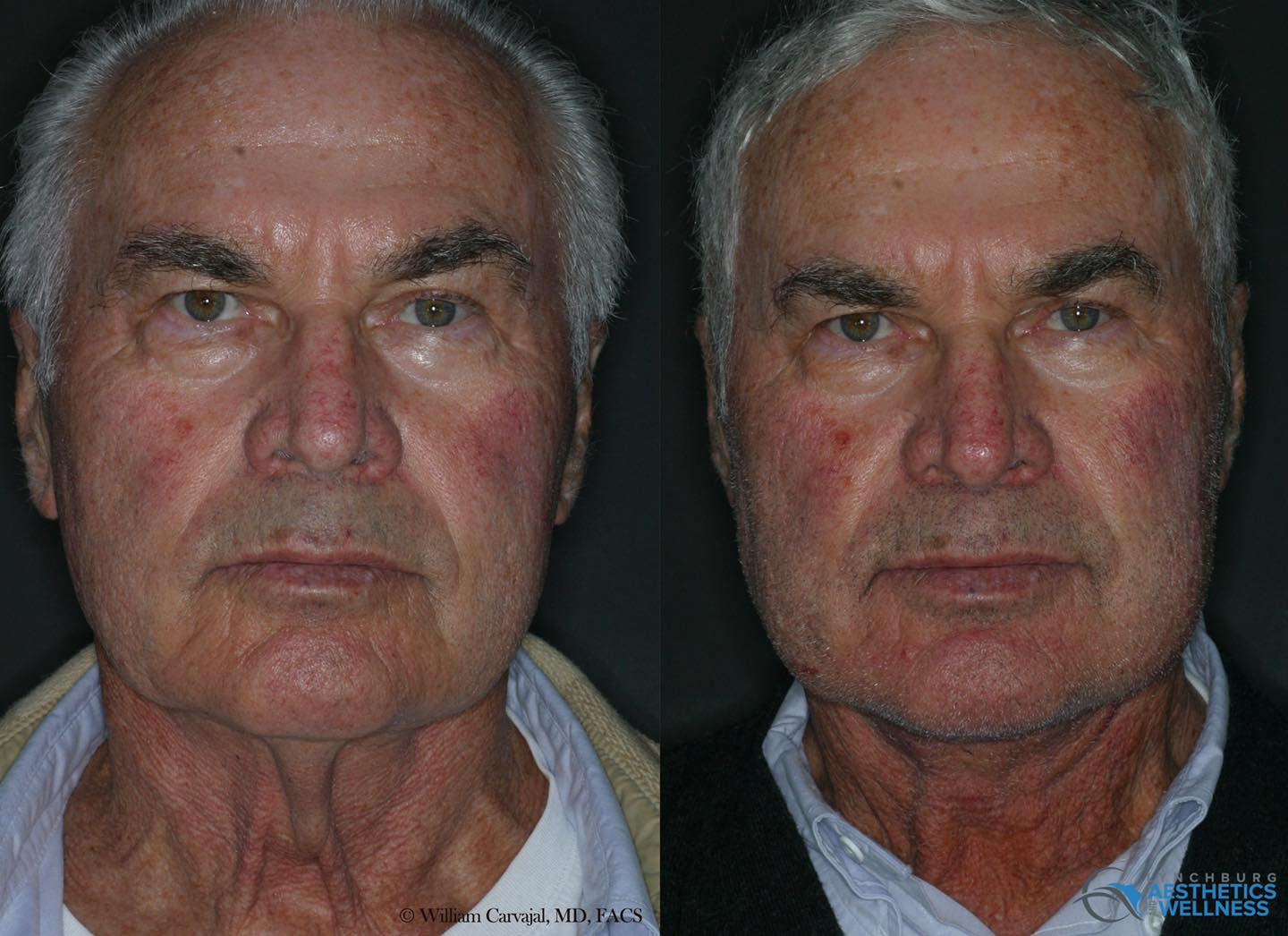
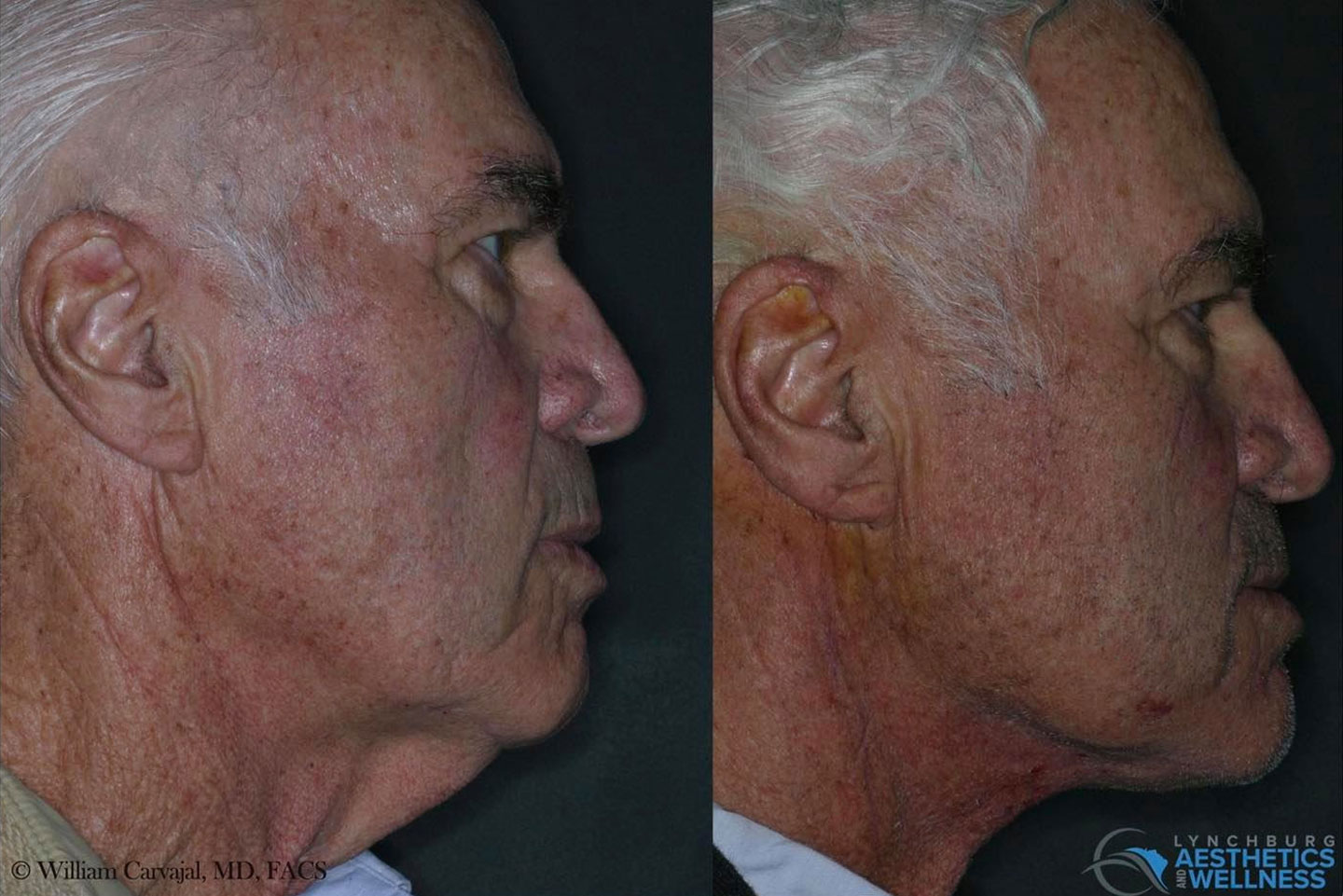
A good facelift doesn’t make you look like someone else. It makes you look like you did ten or fifteen years ago, and nobody can quite put their finger on what changed. That takes a surgeon with a sense of proportion, and it takes one who understands what’s under the skin, because the skin is not what’s sagging. It’s the deeper tissue. Dr. William Carvajal is board certified by the American Board of Facial Cosmetic Surgery and trained in maxillofacial surgery, which means his whole practice is the face, head and neck. Patients travel to Lynchburg from Roanoke, Charlottesville, Richmond and across Virginia for that focus. The before and after below is one of his facelift patients.
Patient Reviews

The staff and team were very encouraging and pleasant to deal with. Thank you so much for your kind and caring concerns. This made the whole experience very pleasant. Dr. Carvajal was great and the whole team from the front desk to the Post Op care.
What Is a Facelift?
The loss of contours in the face can be due to the thinning of the skin, sun damage, smoking, stress, or even heredity. A Facelift, or Rhytidectomy, is a cosmetic surgical procedure that tightens and/or removes excess skin from the face, giving the face a more youthful appearance. A Facelift tightens loose, hanging skin (often called jowls), and a Facelift can remove deep creases and folds around the nose and mouth. A Facelift can also remove fat under the chin and in the neck. A Facelift can also be combined with eyelid surgery or other facial procedures.
Mini Facelift vs Mid Facelift vs Full Facelift
Yes, there’s more than one kind, and the right one depends on where the aging shows. Choosing the smallest procedure that will actually solve the problem is most of the skill. Here’s how Dr. Carvajal thinks about it.
Mini-Facelift
A Mini-Facelift is a surgery technique designed to target aging in the lower face, which includes minimal sagging skin and early jowls. A mini facelift uses shorter incisions than a full facelift, so recovery is quicker and scarring is minimal. Incisions are made above the ear along the hairline, which lets Dr. Carvajal tighten skin and remove excess tissue thereby improving the appearance of jowls and neck. A mini facelift creates a smoother, lifted jawline, but it isn’t built for heavy jowls or a loose neck. For those, a full facelift, often combined with a neck lift, is the honest answer. Patients searching for a mini facelift in Virginia are usually good candidates if they’re in their 40s or early 50s with early jowling.
Mid-Facelift
A Mid-Facelift targets sagging cheeks and is very effective in rejuvenating the midface region. A Mid-Facelift elevates the tissues of the cheeks thereby eliminating sagging and reducing deep creases. A Mid-Facelift is best for individuals who do not have jowls or sagging neck skin. During a Mid-Facelift, Dr. Carvajal will make small incisions in the hairline above the ears, as well as inside the mouth. These allow the fat pads in the cheeks to be repositioned, while also tightening your skin. A Mid-Facelift improves facial definition, creates attractive cheek contours, and eliminates nasolabial folds. A Mid-Facelift will even improve lower eyelids and can be performed in conjunction with other facial procedures.
Traditional Facelift
A Traditional Facelift addresses moderate to advanced aging around the mid-face and neck. A Traditional Facelift is more extensive than a Mini-Facelift; thus, the results are more dramatic. A Traditional Facelift also has a longer period of recovery. For a Traditional Facelift, incisions are positioned just behind the hairline, starting near the temples and around the front of the ear. By creating incisions that are hidden in the skin’s natural fold, Dr. Carvajal repositions the deeper tissue beneath the skin and removes excess skin to smooth creases. During a Traditional Facelift, Dr. Carvajal will also eliminate jowling and sagging skin under the chin. Following a Traditional Facelift, sutures are typically removed in 7-10 days, and patients normally return to work within 10 days. Generally, light exercise can be resumed 2 weeks after surgery.
When Should I Consider a Facelift?
There is no specific age or reason to get a Facelift; however, on average, a person considering a Facelift has deep creases and wrinkling, has lost skin resiliency and firmness, has excess skin around the chin and jawline, has lost facial tone and volume, or always looks tired. Early in life, the face produces plenty of collagen and elastin, which are the two proteins that gives the skin a youthful appearance. However, over time the natural production of the two proteins diminishes leaving facial skin loose and droopy. During your Facelift, Dr. Carvajal will remove excess skin and tighten what remains, which will leave you with a refreshed, youthful appearance.
You may wish to consider a Facelift if:
- You feel self-conscious about the way your face and neck look.
- You wear turtlenecks and scarves to hide your aging neck.
- You feel your face makes you look much older than you feel.
- You believe an aging appearance negatively impacts your career or personal relationships.

Who Is a Good Candidate for a Facelift?
Prior to your Facelift, Dr. Carvajal will perform a complete physical examination. He will review your blood pressure, your ability to blood clot, the medications you take, whether you are a cigarette smoker, your drug use history, your allergies, and your overall skin condition.It is important to remember that living a healthy lifestyle, which includes a balanced diet and getting enough exercise, will help maintain the effects of Facelift surgery. Dr. Carvajal will explain what the surgery will involve, he will discuss the type of anesthesia to be used, your recovery period, and any potential complications that could develop.
Facelift Recovery: What to Expect
Facelift surgery is usually done as an outpatient procedure. You will receive sedatives or general anesthesia, and the procedure usually takes from 2-5 hours. The person undergoing a Facelift normally goes home on the same day after their surgery. Upon completion of your Facelift, Dr. Carvajal may bandage your face to minimize swelling and bruising, and small tubes may be present for a brief period to draw off any type of fluid drainage. Dr. Carvajal will give you specific instructions on how to care for your surgical site, medications to take, and when to follow up with him. Full recovery usually takes about two weeks. Vigorous activity can usually be resumed approximately four weeks after your face lift.
What a Facelift Doesn’t Do
A facelift lifts and repositions. It doesn’t change your bone structure, it doesn’t fix sun-damaged skin texture (that’s what our laser resurfacing is for), and it doesn’t lift the brow or eyelids. Those are separate procedures, brow lift and blepharoplasty, which are often done at the same time. And it doesn’t stop the clock. You’ll keep aging, just from a younger starting point.
Questions to Ask Before Your Facelift
Am I healthy enough to undergo a Facelift? Will I go home the day of my surgery? Will I have bandages after my surgery? What medications will I be taking? Will I have drains? When will my drains and bandages be removed? When can I wash my face? When will my stitches be removed? How long will I be out of work? When can I begin wearing makeup again? When can I begin walking/running again?
Life After Your Facelift
A Traditional Facelift is a complex procedure that requires exceptional surgical knowledge and skill; however, most patients usually recover quite quickly. Typically, a person that undergoes a Facelift return to normal activities about two weeks following surgery. Strenuous exercise will need to wait until about 4 weeks following surgery. For a Mini-Facelift, recovery times are usually even shorter.
As each person heals differently, Dr. Carvajal will give you detailed instructions for aftercare and follow-up. On average, the primary concern patients have following a Facelift is how soon they will look presentable following their procedure. Bruising and swelling are normal after a Facelift and will be at their worst about 2 days after surgery. After that, bruising and swelling will begin to fade and should be difficult to notice after about 2 weeks.
Dr. Carvajal will advise you as to when you can begin wearing make-up following your period of recovery. After you get back into the routine of your life, it is extremely important to protect your face from the sun. For several weeks following your surgery, you will be vulnerable to sunburn. Staying out of the sun will also help your scars heal. If you must be out in the sun, wear a hat and apply sunscreen regularly.
Facelift FAQ
How much does a facelift cost in Virginia?
It depends on whether you need a mini, mid or full facelift, whether it’s combined with a neck lift or eyelid surgery, and the anesthesia involved. We give you a written quote at your consultation, and financing is available. Call 434-616-4986 to ask about current pricing.
Facelift or neck lift, which do I need?
If the problem is jowls and sagging cheeks, a facelift. If it’s loose skin, bands or fullness under the chin, a neck lift. Most patients over 55 need both, and doing them together means one recovery. For early neck laxity without much skin excess, MyEllevate is a lighter option.
What’s the best age for a facelift?
There isn’t one. Most facelift patients are between 45 and 70. Earlier means a smaller procedure and a longer-lasting result; later means more to correct but still a dramatic change. Skin quality and health matter more than the number.
How long does a facelift last?
Around ten years for a full facelift, often longer. A mini facelift lasts less. You keep aging afterwards, but from a younger baseline, and you’ll always look better than if you hadn’t had it.
Will people be able to tell?
They’ll notice you look rested and well. They shouldn’t be able to say why. Incisions sit in the hairline and the natural creases around the ear, and Dr. Carvajal’s approach is to reposition deep tissue rather than pull skin tight, which is what causes the wind-tunnel look people are afraid of.
Do I have to live in Lynchburg?
No. Patients come from Roanoke, Charlottesville, Richmond, Danville and elsewhere in Virginia, and some from North Carolina. Surgery is outpatient, so you’ll need someone to drive you home and stay with you the first night. We’ll help you plan follow-up visits around the drive.
Facelift Consultation in Lynchburg, VA
The consultation is where you find out which facelift, if any, is right for you. Dr. Carvajal will look at your face, listen to what bothers you, and tell you plainly what surgery can and can’t fix. Schedule a consultation or call 434-616-4986.